SoilWise Geopackage
Observed Property
Definition
An ObservedProperty is a property of a Feature that is being observed by a Sensor, such as temperature, humidity, population count or color. It should be uniquely identified by its definition, which should point to an external vocabulary by means of a URL, URI or DID. 1
SensorThings API 2.0 (23-019) (DRAFT),
version 23-019.
https://hylkevds.github.io/23-019/23-019.html
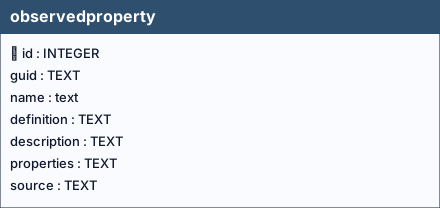
Table: observedproperty
Columns
| Name | Type | Constraints | Description |
|---|---|---|---|
id |
INTEGER |
PRIMARY KEY | A unique, read-only attribute that serves as an identifier for the entity. |
guid |
TEXT |
Universally unique identifier. | |
name |
TEXT |
NOT NULL | A property provides a label for ObservedProperty entity, commonly a descriptive name. |
definition |
TEXT |
NOT NULL | The URI of the ObservedProperty. Dereferencing this URI SHOULD result in a representation of the definition of the ObservedProperty. The definition SHOULD be unique in a service. |
description |
TEXT |
A description about the ObservedProperty. | |
properties |
TEXT |
mime type: ‘application/json’. A JSON Object containing user-annotated properties as key-value pairs. | |
source |
TEXT |
NOT NULL, DEFAULT ‘Local’ | Indicate the origin of the data. In the case of the insertion of new properties by the user, these will be marked with the label «Local». |
Table Identifiers
In this table, the primary key is the id field (integer, auto-incrementing).
There is also a text field named GUID, which stores a UUID (Universally Unique Identifier) compliant with RFC 4122.
Although GUID is not mandatory at the schema level (it is not declared NOT NULL), its functional requirement is enforced by two triggers:
- observedpropertyguid (INSERT) trigger: if GUID is missing or empty, a correctly formatted UUID is generated and inserted automatically.
- observedpropertyguidupdate (UPDATE) trigger: prevents any modification of GUID after insertion, making it immutable (effectively behaving as a stable key).
Any foreign keys (FK) from other tables reference this table’s GUID field rather than the id field, ensuring stable and interoperable references across datasets and database instances.
Note
GUID management is handled by database triggers, which ensure their automatic generation at the time of record insertion, without any user involvement.
Relationships (as child)
- None
Referenced by (as parent)
datastream.guid_observedproperty→observedproperty.guid(ON UPDATE CASCADE, ON DELETE CASCADE)obsprocedure_obsdproperty.guid_observedproperty→observedproperty.guid(ON UPDATE CASCADE, ON DELETE RESTRICT)
Indexes
- None
Triggers
For every trigger you will find:
- When it runs (BEFORE/AFTER, INSERT/UPDATE/DELETE)
- What it reads and compares (columns, lookups in other tables)
- What happens on success (the statement proceeds, optional updates)
- What happens on failure (the exact error text raised)
observedpropertyguid / observedpropertyguidupdate
When they run: AFTER INSERT / AFTER UPDATE OF guid
What they do: Assign GUID at insert when missing; block later changes.
If the check passes: Insert writes GUID; unchanged updates proceed.
If the check fails: On change, abort with: Cannot update guid column.
-
Hylke van der Schaaf — Open Geospatial Consortium (OGC), ↩