SoilWise Geopackage
Sensor
A Sensor is an entity that observes a property or phenomenon with the goal of producing an estimate of the value of the property. A Sensor may represent a piece of hardware, but a Sensor may also be a human or an algorithm implemented in software.
A Sensor entity in an OGC SensorThings API deployment can represent either a specific sensor instance, or a more generic sensor type. The distinction is generally quite clear from the Sensor metadata. Does the entity have detailed metadata that is specific to a sensor instance, like a serial number and calibration data, or is it used for many Datastreams attached to many different Things.
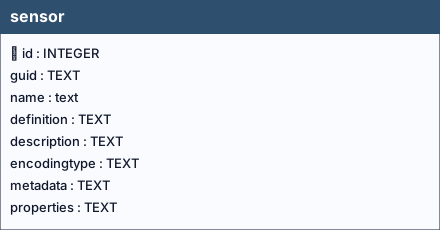
Table: sensor
Columns
| Name | Type | Constraints | Description |
|---|---|---|---|
id |
INTEGER |
PRIMARY KEY | A unique, read-only attribute that serves as an identifier for the entity. |
guid |
TEXT |
Universally unique identifier. | |
name |
TEXT |
NOT NULL | A property provides a label for Sensor entity, commonly a descriptive name. |
definition |
TEXT |
The URI linking the Thing to an external definition. Dereferencing this URI SHOULD result in a representation of the definition of the Thing. | |
description |
TEXT |
The description of the Sensor entity. | |
encodingtype |
TEXT |
The encoding type of the metadata property. If the metadata field is present, an encodingType must be specified. | |
metadata |
TEXT |
The detailed description of the Sensor or system. The metadata type is defined by encodingType. | |
properties |
TEXT |
mime type: ‘application/json’. A JSON Object containing user-annotated properties as key-value pairs. |
Table Identifiers
In this table, the primary key is the id field (integer, auto-incrementing).
There is also a text field named GUID, which stores a UUID (Universally Unique Identifier) compliant with RFC 4122.
Although GUID is not mandatory at the schema level (it is not declared NOT NULL), its functional requirement is enforced by two triggers:
- sensorguid (INSERT) trigger: if GUID is missing or empty, a correctly formatted UUID is generated and inserted automatically.
- sensorguidupdate (UPDATE) trigger: prevents any modification of GUID after insertion, making it immutable (effectively behaving as a stable key).
Any foreign keys (FK) from other tables reference this table’s GUID field rather than the id field, ensuring stable and interoperable references across datasets and database instances.
Relationships (as child)
- None
Referenced by (as parent)
datastream.guid_sensor→sensor.guid(ON UPDATE CASCADE, ON DELETE CASCADE)obsprocedure_sensor.guid_sensor→sensor.guid(ON UPDATE CASCADE, ON DELETE RESTRICT)
Indexes
- None
Triggers
For every trigger you will find:
- When it runs (BEFORE/AFTER, INSERT/UPDATE/DELETE)
- What it reads and compares (columns, lookups in other tables)
- What happens on success (the statement proceeds, optional updates)
- What happens on failure (the exact error text raised)
sensorguid / sensorguidupdate
When they run: AFTER INSERT / AFTER UPDATE OF guid
What they do: Assign GUID at insert when missing; prevent changes later.
If the check passes: Insert writes GUID; unchanged updates proceed.
If the check fails: On change, abort with: Cannot update guid column.