SoilWise Geopackage
Soil Body Geom
Definition
The
soilbody_geomtable is used to store the geometric representation of soil bodies. Geometry management is intentionally separated from thesoilbodytable in order to provide greater flexibility in spatial representation. By decoupling geometry from soil body attributes, this design allows a single soil body to be associated with multiple geometries at different spatial scales. This approach supports the creation of maps at various resolutions and cartographic scales within the same GeoPackage, without duplicating soil body attribute data.
The soilbody_geom table therefore enables multi-scale spatial visualization and analysis, facilitating the management of generalized and detailed geometries while maintaining consistency across representations.
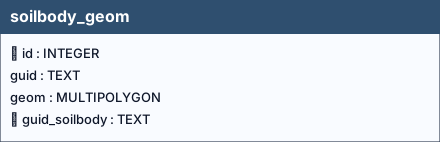
Table: soilbody_geom
Columns
| Name | Type | Constraints | Description |
|---|---|---|---|
id |
INTEGER |
PRIMARY KEY | Primary Key of the Table. |
guid |
TEXT |
Universally unique identifier. | |
geom |
MULTIPOLYGON |
NOT NULL | Geometry. |
guid_soilbody |
TEXT |
NOT NULL | Foreign key to the SoilBody table. |
Table Identifiers
In this table, the primary key is the id field (integer, auto-incrementing).
There is also a text field named GUID, which stores a UUID (Universally Unique Identifier) compliant with RFC 4122.
Although GUID is not mandatory at the schema level (it is not declared NOT NULL), its functional requirement is enforced by two triggers:
- soilbody_geomguid (INSERT) trigger: if GUID is missing or empty, a correctly formatted UUID is generated and inserted automatically.
- soilbody_geomguidupdate (UPDATE) trigger: prevents any modification of GUID after insertion, making it immutable (effectively behaving as a stable key).
Any foreign keys (FK) from other tables reference this table’s GUID field rather than the id field, ensuring stable and interoperable references across datasets and database instances.
Note
GUID management is handled by database triggers, which ensure their automatic generation at the time of record insertion, without any user involvement.
Relationships (as child)
soilbody_geom.guid_soilbody→soilbody.guid(ON UPDATE CASCADE, ON DELETE CASCADE)- Note: delete on
soilbodycascades tosoilbody_geom.
- Note: delete on
Referenced by (as parent)
- None
Indexes
| Name | Unique | Columns | Origin | Partial |
|---|---|---|---|---|
idx_soiBody_geom |
No | geom |
c |
No |
Triggers
For every trigger you will find:
- When it runs (BEFORE/AFTER, INSERT/UPDATE/DELETE)
- What it reads and compares (columns, lookups in other tables)
- What happens on success (the statement proceeds, optional updates)
- What happens on failure (the exact error text raised)
soilbody_geomguid / soilbody_geomguidupdate
When they run: AFTER INSERT / AFTER UPDATE OF guid
What they do: Assign GUID when missing at insert; prevent changes later.
If the check passes: Insert writes GUID; unchanged updates proceed.
If the check fails: On change, abort with: Cannot update guid column.