SoilWise Geopackage
Other Horizon - Profile Element
Definition
The
otherhorizon_profileelementtable defines a many-to-many relationship between soil profile elements and alternative horizon notations, linking theprofileelementandotherhorizonnotationtypetables. This relationship allows a single profile element (horizon) to be associated with one or more additional horizon notation types and, conversely, enables the same horizon notation to be applied to multiple profile elements.
Note
Before assigning alternative horizon notations to a soil profile element, the relevant otherhorizonnotationtype entries must be defined.
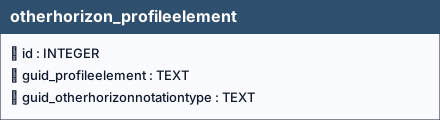
Table: otherhorizon_profileelement
Columns
| Name | Type | Constraints | Description |
|---|---|---|---|
id |
INTEGER |
PRIMARY KEY | Primary Key of the Table. |
guid_profileelement |
TEXT |
NOT NULL | Foreign key to the ProfileElement table, guid field. |
guid_otherhorizonnotationtype |
TEXT |
NOT NULL | Foreign key to the OtherhorizonNotationType table, guid field. |
Relationships (as child)
otherhorizon_profileelement.guid_otherhorizonnotationtype→otherhorizonnotationtype.guid(ON UPDATE CASCADE, ON DELETE CASCADE)- Note: delete on
otherhorizonnotationtypecascades tootherhorizon_profileelement.
- Note: delete on
otherhorizon_profileelement.guid_profileelement→profileelement.guid(ON UPDATE CASCADE, ON DELETE CASCADE)- Note: delete on
profileelementcascades tootherhorizon_profileelement.
- Note: delete on
Referenced by (as parent)
- None
Indexes
- None
Triggers
For every trigger you will find:
- When it runs (BEFORE/AFTER, INSERT/UPDATE/DELETE)
- What it reads and compares (columns, lookups in other tables)
- What happens on success (the statement proceeds, optional updates)
- What happens on failure (the exact error text raised)
i_ceckothprofileelementtype / u_ceckothprofileelementtype
When they run: BEFORE INSERT / BEFORE UPDATE
What they do: Ensure the linked profileelement is HORIZON (profileelementtype = 0).
If the check passes: Statement proceeds.
If the check fails: Aborts with: Table otherhorizon_profileelement: The associated profileelement must have profileelementtype = 0 (HORIZON).